Leggy basil is almost always short of light. Lower the lamp to 5–10cm above the leaves, run it 16 hours a day, and pinch each stem above the second leaf pair once a week. Most smart-garden owners hit this around week four. The seedlings have come up, the pods look healthy, and the kitchen finally smells faintly of basil. Then the basil starts behaving badly: a tall, bare stem with three small leaves at the top, leaning toward the light arm like it’s trying to escape. It looks nothing like the photo on the box.
I’ve seen this play out in my own kitchen more than once. The good news: it’s entirely fixable, almost always with one small change to your weekly routine. Here’s what’s actually going on, and the 30-second habit that turns the plant around.
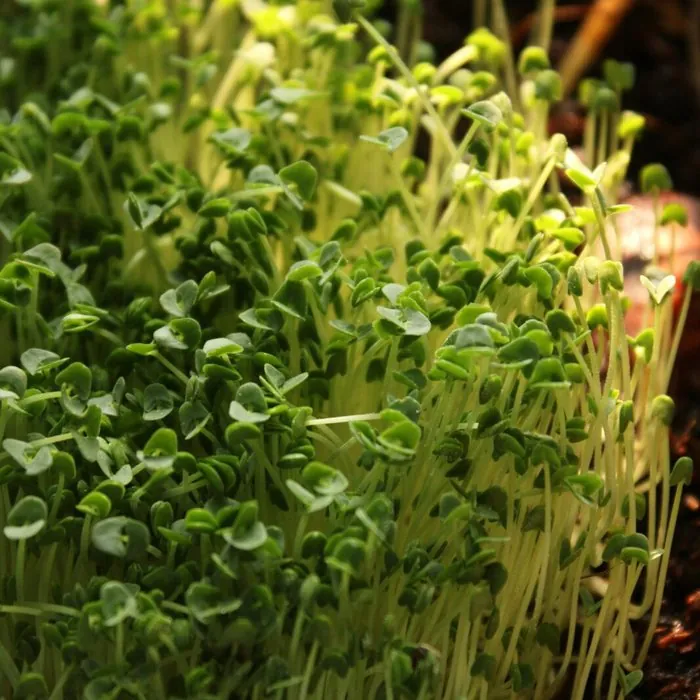
When a plant produces long stretches of bare stem between leaves, horticulturists call it etiolation. The plant has decided it isn’t getting enough light, so it’s spending its energy on vertical reach rather than leaf production. Every centimetre of bare stem is a centimetre of basil you’re not eating.
It is entirely normal in basil. Basil is a tropical herb that stretches hard toward the light. Take away the bright overhead sun and replace it with a 25W LED 30cm above the canopy, and the plant does what evolution trained it to do: it stretches.
Three things cause it (in order of frequency)
Almost every case of leggy basil in a smart garden traces to one of three things, and usually the first.
1. The light is too far away
This is the single most common cause. Most smart gardens ship with adjustable light arms set at a higher-than-optimal default, either from the manufacturer or because users position it high at first to avoid scorching seedlings. The lamp works best 5–10cm directly above the canopy, but most owners never adjust it downward. That distance becomes a chronic light deficit: the basil receives too little light and responds by stretching its stems in search of more, rather than producing leaves. The result is a tall, thin plant with sparse foliage, exactly the opposite of what you want.
2. The light cycle is too short
Some systems default to 12 or 14 hours of light per day. Basil thrives on 16. If you’ve adjusted the cycle down to save electricity or because the brightness bothered you in the evening, your basil noticed. Best practice: 16 hours on, 8 hours off, on a consistent daily cycle.
3. Nobody is pinching it
Basil, left alone, will grow upward indefinitely. The plant’s default strategy is “one tall stem with one growing tip.” Without intervention, that’s what you get. The fix is to interrupt the default, and it takes thirty seconds a week.
The 30-second fix
Once a week, find the topmost cluster of leaves on each basil plant. Trace down two leaf-pairs from the top: the second “true leaf node,” the second set of full-sized leaves below the growing tip. Pinch the stem off cleanly with your fingernails just above that second node. Discard the top growth or throw it on a salad. If the lamp is the problem, our guide to what actually grows well in a smart garden explains why basil sits in the top tier once the light is right.
That’s the entire fix. Every plant. Every week. From the moment the first set of true leaves appears.
Why it works
Plants have a hormonal system called apical dominance. The growing tip at the top of each stem produces auxins that suppress the lateral buds further down, the side shoots that would otherwise branch outward. Pinch off the top, and the suppression lifts. Within a few days, each leaf node below the pinch point starts producing its own lateral shoot. One stem becomes two, then four, then eight.
The result is a far bushier plant with much more leaf than an unpinched stem. The honest comparison: a pinched basil in a Click & Grow Smart Garden 3 produces more usable leaf than an unpinched basil in a Smart Garden 9. The pruning regimen matters more than the pod count.
Never let basil flower. If you see small green buds forming at the tip of any stem, pinch them off immediately. Once basil flowers, the plant shifts its energy to seed production and leaf yields collapse. The pinching regimen above prevents flowering as a side effect, so keep at it.
A reader who pinches weekly and raises the lamp arm weekly as the plant grows is unlikely to ever ask why their basil is leggy. A reader who does neither will ask the question every six weeks for as long as they own the unit. The difference is about a minute of attention a week, which works out to a remarkable yield-per-minute return. If you want the light and the watering handled for you, Metro Solo runs both on a schedule.
Quick answers
Should you pick basil from the top or the bottom?
From the top. Pinch just above a leaf pair near the tip, and the plant branches below the cut. Picking the big leaves from the bottom leaves the tall, bare stem in place and makes legginess worse.
Why are my basil leaves light green?
Usually hungry roots or too little light. In a smart garden, top up the nutrient on schedule and check the lamp is 5–10cm above the leaves. Pale new growth with dark old leaves points to nutrients; pale and stretched points to light.
Is my basil overwatered or underwatered?
Drooping leaves that recover after a top-up mean thirst. Yellowing lower leaves and soft, dark stems at the base mean too much water or a fouled wick. In a pod system, check the reservoir and the wick before anything else.

About the author. Nathaniel Young is a co-founder of Metro Farms. He has a natural sciences degree from Utrecht University, wrote his thesis on policy for vertical farming in Manchester, and has worked in kitchens and bars. He writes about growing food indoors the practical way, with practical, tested advice. More from Nathaniel Young